Products





24 HOURS SERVICE


CUSTOM SERVICE


INSTALLATION SERVICE


INTELLIGENT SCHEME


PRODUCTION PROCESS
PRODUCT
PRODUCT
Open+
Close-
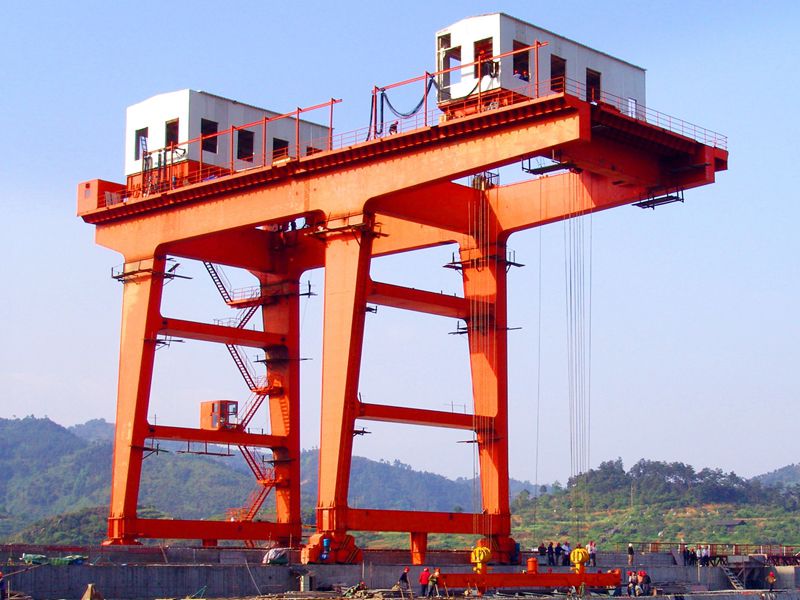
Hydroelectric power station lifting crane
PRODUCT DETAILS
Open+
Close-
Rated lifting capacity 25 t – 500 t
Span (gauge) 8 m – 60 m
Lifting height 30 m – 140 m
Hoisting speed 0.5 m/min – 5 m/min
Crane travel speed 15 m/min – 30 m/min
Trolley travel speed 5 m/min – 10 m/min
Slewing hoist capacity 16 t – 50 t
Slewing radius 7 m – 12 m
Duty class A3 – A8
Deion
The dam crest gantry crane is a gantry crane installed on the crest of a hydropower station dam. Most are bidirectional or unidirectional travelling gantry cranes, consisting of a main hoisting trolley, a slewing hoisting mechanism, a crane travel mechanism, a gantry frame, an operator’s cab, various electrical devices and protection devices. It is mainly used for opening and closing the intake service gate, the flood retaining gate at the upper lock head of the shiplock, lifting heavy components of the turbine, and for the installation and maintenance of the flushing gate operating gate and its fixed hoist. It also transports gates to the gate service bay for repair and storage. The slewing hoist is used for lifting small equipment on the dam crest.
Classification by movement direction
Unidirectional dam crest gantry crane: The trolley has no travel mechanism, only the crane travel mechanism; the whole crane moves only in one direction along the dam.
Bidirectional dam crest gantry crane: The crane travels along the dam direction, while the trolley travels along the water flow direction, covering a larger working area.
Classification by functional configuration
Standard dam crest gantry crane: Equipped with a main hoisting trolley and a slewing hoisting mechanism, mainly for gate opening/closing and general lifting operations.
Inclined‑lifting dam crest gantry crane: Equipped with inclined‑lifting capability to lift gates at an inclined angle.
Classification by rail type
Straight‑rail gantry crane: Operates on straight rails; a common type of traditional dam crest gantry crane.
Curved‑rail gantry crane: Operates on curved rails.
Classification by number of hoisting mechanisms
Single‑trolley dam crest gantry crane: Has only one main hoisting mechanism.
Double‑trolley dam crest gantry crane: Equipped with two (main and auxiliary) or multiple hoisting mechanisms.
Classification by lifting attachment
Hook‑type gantry crane: Uses a standard hook for lifting.
Beam‑grab type gantry crane: Equipped with a hydraulic beam grab and other dedicated spreaders for automatically grabbing and releasing gates.
Combined trash‑cleaning gantry crane: Integrates a hydraulic grab cleaner into the gantry hoist, enabling both gate operation and trash cleaning – especially suitable for cramped hydraulic structures.
Structure and components
The overall structure of a dam crest gantry crane is essentially the same as that of a general gantry crane, mainly consisting of the following parts:
Gantry frame: The supporting skeleton of the whole crane, a welded box‑girder structure. Its design must satisfy strength, stiffness, horizontal rigidity, overall stability, and anti‑overturning requirements.
Main hoisting trolley: The core working mechanism of the dam crest gantry crane, responsible for opening/closing and lifting the main gates. The hoisting mechanism of large‑scale cranes has moved away from traditional spiral winding and uses broken‑line drum technology. The drum grooves form a closed line of straight → slanted → straight → slanted, allowing the wire rope to wind back and forth multiple times (forward → reverse → forward → reverse), keeping the winding orderly without misalignment or jumping, and reducing wear and squeezing during multi‑layer winding.
Slewing hoisting mechanism (slewing hoist): Dam crest gantry cranes are usually provided with a slewing hoist on the downstream side or on the crossbeam of the gantry legs, used for installing and maintaining the crest hydraulic hoists and lifting small equipment on the dam crest. The slewing hoist mechanism also often uses broken‑line drum technology, featuring high lift and long boom. The slewing range is generally 180°, with the slewing radius customised to requirements.
Crane travel mechanism: Drives the entire gantry crane longitudinally along the dam crest rails to reach different gate bays. The travel distance can be hundreds of metres, and the speed is generally low (approx. 20 m/min) to meet precise positioning requirements.
Trolley travel mechanism (for bidirectional cranes): For bidirectional dam crest gantry cranes, the trolley travel mechanism moves the trolley along the water flow direction. The travel distance is relatively short (e.g., 8.6 m) and the speed is low (approx. 6 m/min).
Spreader and beam grab: The dam crest gantry crane is equipped with dedicated spreaders for gate operation. Common spreaders include beam grabs for automatically grabbing and releasing gates. Beam grabs can be equipped with hydraulic devices for automatic hooking and unhooking.
Electrical control system: The electrical control system of dam crest gantry cranes typically uses variable‑frequency drives for the hoisting mechanism and the crane/trolley travel mechanisms. To ensure reliable operation in harsh environments, all motors have insulation grades suitable for the high altitude and large temperature differences of hydropower projects. The control system supports both local operation and remote control.
Safety devices: The dam crest gantry crane is equipped with comprehensive safety devices, including overload limiters, limit switches, anemometers, rail clamps (top‑rail clamps), buffers, wind‑proof anchoring devices, etc. Under adverse weather conditions, the rail clamps and anchoring devices ensure equipment safety.
Main application scenarios
Floodgate opening/closing and lifting: On the spillway section, the dam crest gantry crane is used to open/close and lift various flood‑discharge gates, such as the spillway emergency gate, deep outlet gate, and bottom sand‑sluicing emergency gate.
Power intake gate and trash rack operation: On the intake section of the hydropower station, the dam crest gantry crane operates the intake service gate, emergency gate, and trash rack.
Gate installation, repair, and transport: The dam crest gantry crane can transport various gates to the gate service bay for repair and storage. When a gate needs repair or replacement, the gantry crane works together with the fixed hoist; after the gate is lowered to the specified position, the crane completes the lifting and transport, and after repair, it cooperates to reposition the gate and restart operation.
Installation and maintenance of hydraulic hoists and other equipment: The slewing hoist of the dam crest gantry crane is mainly used for installing and maintaining the crest hydraulic hoists on the downstream side.
Trash cleaning: The combined trash‑cleaning gantry crane integrates a hydraulic grab cleaner into the gantry hoist, using the dam crest gantry crane as the suspension point for the travel mechanism and hoisting mechanism. Its working area covers the trash rack, simultaneously performing trash‑cleaning operations.
Turbine component lifting: The dam crest gantry crane can be used for lifting and installing/maintaining heavy turbine components such as runners, head covers, and main shafts.
PRODUCT INFO
Open+
Close-
Core Features
High lifting capacity and great lifting height: The objects handled by the dam crest gantry crane (hydraulic gates) are extremely heavy, therefore the lifting capacity requirement is very high.
Highly stable operation and precise positioning: The hoisting speed and the crane/trolley travel speeds are designed to be relatively low, typically within the range of 15 m/min. Although the speeds are low, this places extremely high demands on the stability of the hoisting mechanism, the uniformity of movement, and the accuracy of positioning.
High duty class and stringent safety requirements: Although the dam crest gantry crane is not used for lifting operations frequently, when it is used the work is heavy and involves the safety of dam operation, therefore its safety and reliability requirements are extremely high. The dam crest gantry crane needs a high duty class (A6–A8) to ensure that it can withstand high‑intensity usage frequency and complex stress conditions over a long service life.
Strong weather resistance and adaptability to harsh environments: The dam crest gantry crane is installed on the top of a hydropower dam, long‑term exposed to natural environments with high altitude, strong wind and sand, large temperature differences, and high humidity. The crane must maintain reliable operation year‑round under extremely harsh environmental conditions. Therefore, the metal structure of the equipment must be designed for high strength and high fatigue resistance; the electrical system must have good moisture‑proof and freeze‑proof capabilities; and the entire machine must also be corrosion‑resistant and able to withstand wind and snow.
High degree of automation and intelligence: The hoisting mechanism and the crane/trolley travel mechanisms all use variable‑frequency drive motors, achieving stepless speed regulation and smooth start/stop. The control system can support both local operation and remote control.

PRODUCT PHOTO

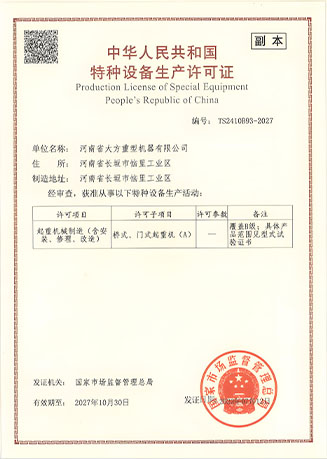
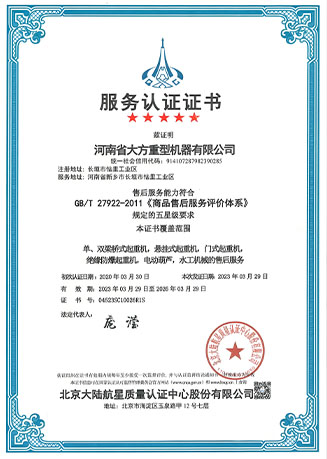
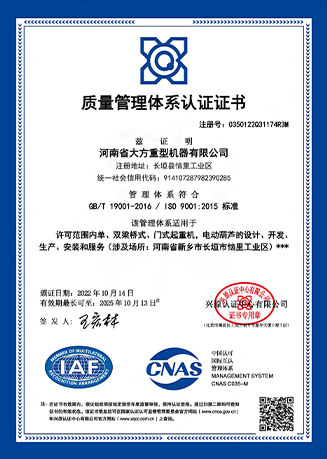
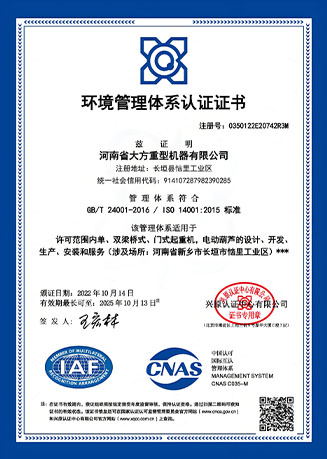
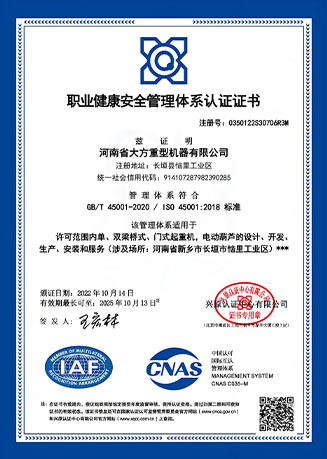
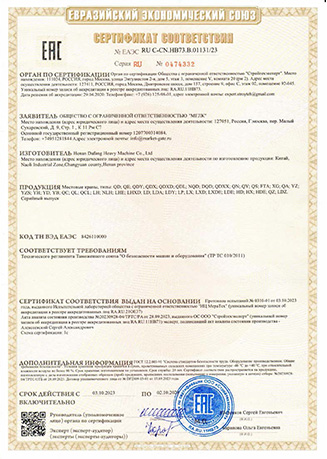
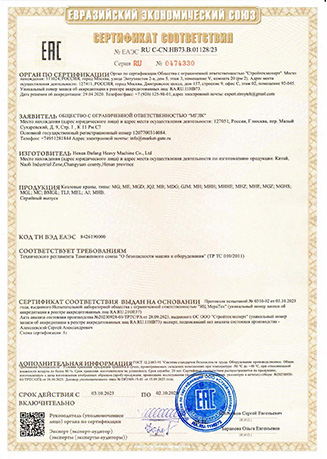
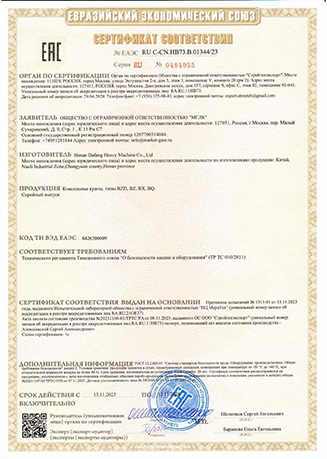
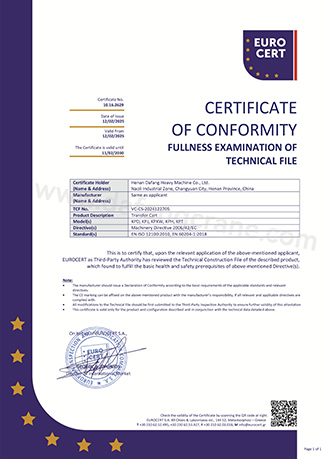
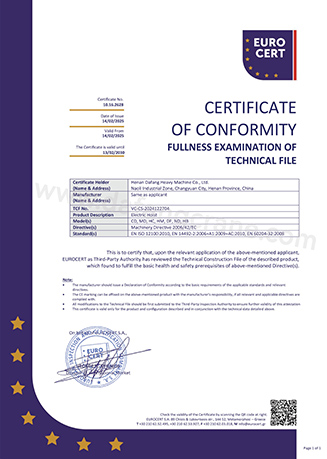
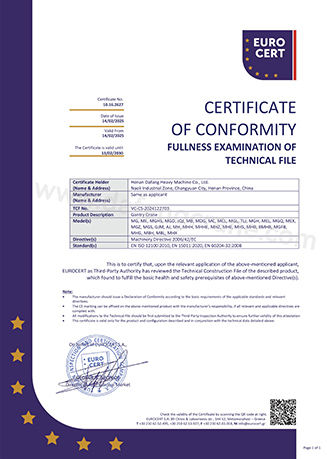
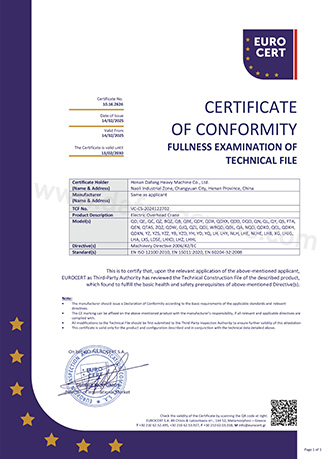
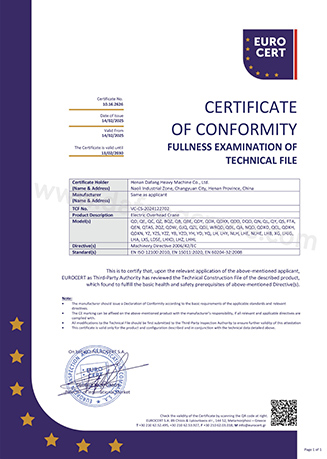


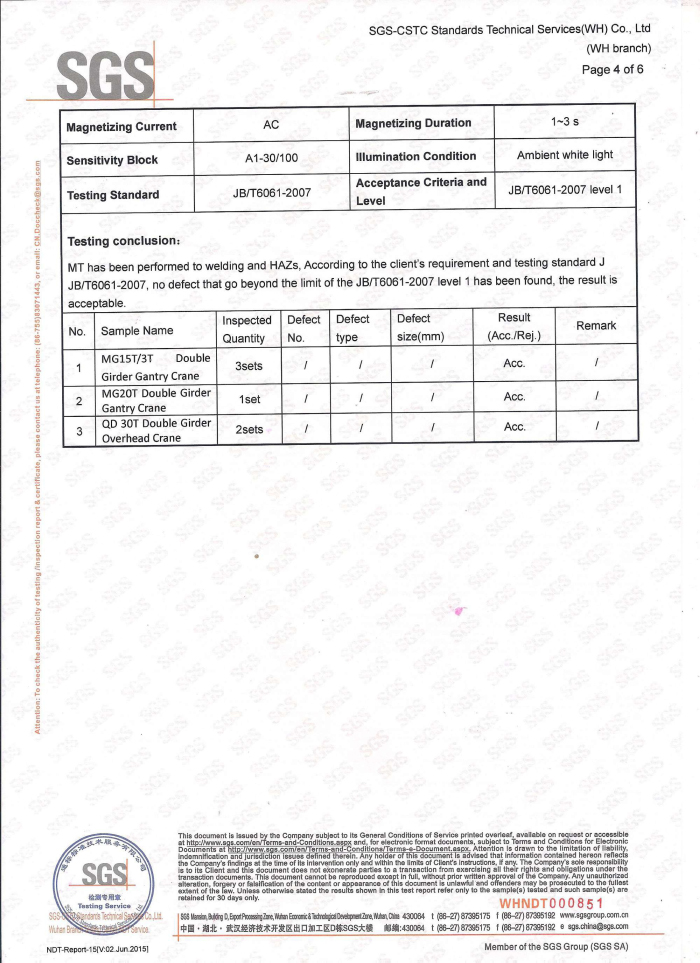
Certificate